About the studio · Brighton Beach, Brooklyn

02 / about

zipper & thread

A localization studio three languages wide, on the block between Brighton Beach Avenue and the Atlantic.

We translate and culturally adapt the parts of a SaaS product that get read in the first ten minutes: onboarding screens, help-center articles, UI strings. Spanish, Brazilian Portuguese and Japanese. Everything else, we decline the same day, with a reason.

Two linguists per language. One price per language, given before we start. One glossary per project, which leaves with you and imports into Lokalise, Crowdin or Phrase.

glossary.csv · row 1Approved

Term
Zipper & Thread
Part of speech
Proper noun
Translate?
No. In any locale.
Rejected
Cremallera y HiloZíper e Linhaジッパーと糸
Reason
It’s a name. Also, the Spanish is three syllables longer and would not fit the invoice header.
Note (JA)
Written in Latin letters. Reading ジッパー・アンド・スレッド supplied for phone calls only.
  • Address3130 Brighton 7th, Brooklyn, NY 11235
  • Nearest trainB and Q, Brighton Beach
  • Friday closing2pm, sharp
  • Languages declinedAll the others
The studio desk on Brighton 7th in late-morning light: two laptops, one showing a Japanese onboarding screen and one a string file, beside a tabbed glossary, a brass zipper pull and a spool of rust thread.

Brighton 7th, late morning. The desk faces the window. The screens face away from it, on purpose.

On the name

the name is the job description

zipper

noun/ˈzɪp.ər/

Two sides, joined one tooth at a time. Skip one and the whole thing opens on the way up.

In a string file, the two sides are en.json and es.json. Every key on the left gets exactly one key on the right. No orphans, no duplicates, and no {firstName} that comes back as {nombre} and breaks the welcome screen for everyone named anything.

In the work: key parity, variables, plural forms, truncation.

thread

noun/θrɛd/

One continuous line through everything it holds together. Mostly invisible when it’s done right.

In a product, the thread is the voice. The welcome screen, the third tooltip, the trial-ending email on day 12 and the 404 page should sound like one person wrote them — because in each language, one person did, and a second person checked.

In the work: the tone memo, tú or usted, você, です・ます, the glossary.

On the address

The studio is at 3130 Brighton 7th, a block from the boardwalk. Walk to the corner for coffee and you will hear more languages than we offer, which keeps us modest about the three we do.

Three is not a starting point we plan to grow out of. It is the plan. Spanish, Brazilian Portuguese and Japanese are where most of the products that write to us want to go next, and keeping the list short is the only way each language gets a translator, a separate reviewer, a staging pass and a glossary meant to outlive the project.

We bill per project, per language, once. The number on the quote is the number on the invoice, unless your source file changes by more than 5% — and then you hear about it before anyone touches the new strings.


Locale sheet · current version

five locales we write, and how each one says the date

This is page one of the tone memo every onboarding package starts from. Yours will be longer, and about your product. The date column is 3 November 2026 — the trial end date a literal pass usually gets wrong.

Locale conventions for the five locales Zipper & Thread writes
Locale How it says “you” 3 Nov 2026 1,250.50 becomes What we check first
ES-419Spanish, Latin America (neutral) tú; usted for banking and health apps 3/11/2026 Depends on the country. We ask which one. Words only one country uses. “Celular” stays; “carro” gets a conversation.
ES-MXSpanish, Mexico tú 03/11/2026 1,250.50 “Computadora,” never “ordenador.”
ES-ESSpanish, Spain tú; vosotros in the plural 3/11/2026 1.250,50 “Ordenador,” never “computadora.” Vosotros in plural CTAs.
PT-BRPortuguese, Brazil você 03/11/2026 1.250,50 “Cadastro” for signup. “Senha,” not “palavra-passe.”
JA-JPJapanese Usually omitted. です・ます by default. 2026年11月3日 1,250.50 Katakana or English for product nouns. No line break inside ワークスペース.
Not on the sheetFrench, German, Italian, Korean, Chinese, European Portuguese. We say no the same day, with a reason.

The sheet scrolls sideways. Like most locale sheets.

Need one of these rows for your product? Packages start at $1,140 per language.

Mon–Thu 11am–7pm · Fri to 2pm

what the hours are actually for

Not every project fits inside one week. Every week looks like this, which is how a quote can say “10 business days” and mean it. Mornings are for writing. Calls start after 1pm.

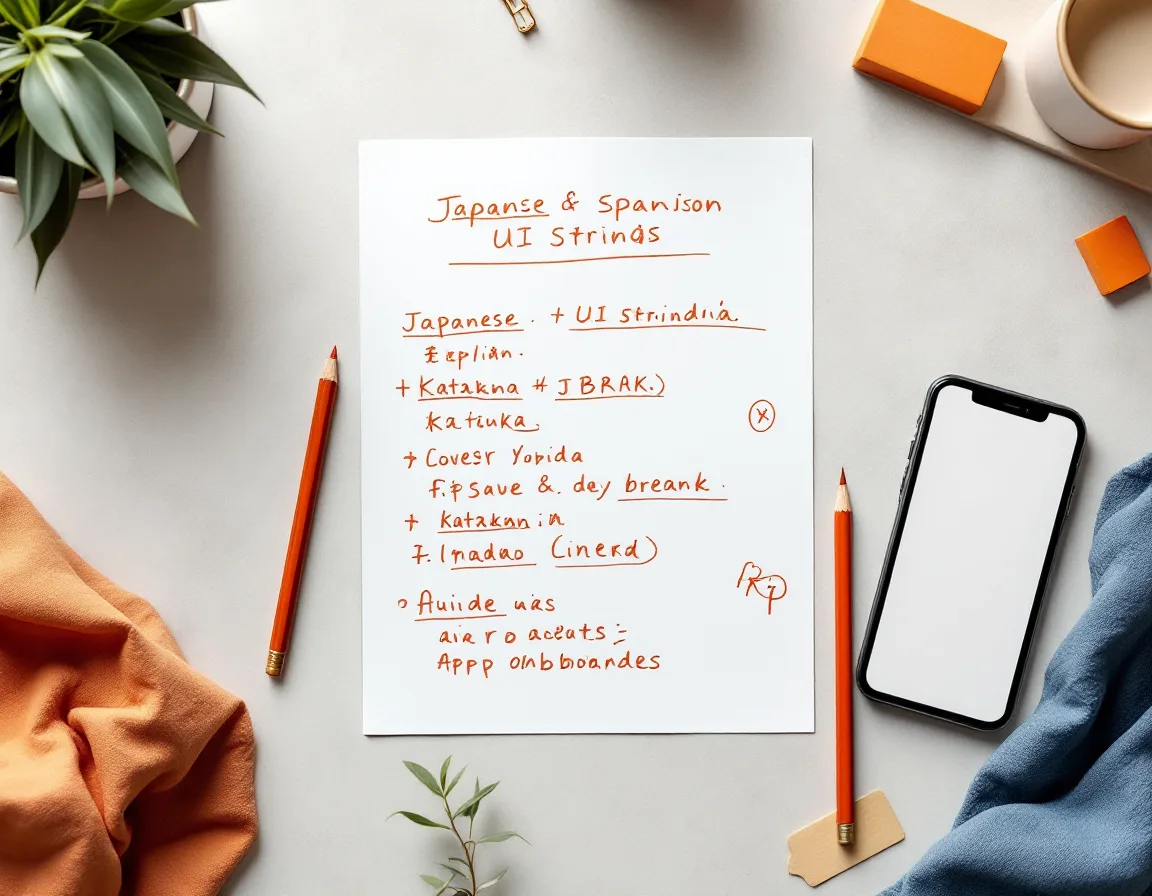
A printed sheet of Japanese and Spanish UI strings marked up in rust pencil, katakana circled, next to a phone showing a Japanese onboarding screen.
  1. monday

    11–7

    • Scopes that arrived after Friday 2pm, read in the order they came in.

    • Quotes go out. One number per language.

    • Trial accounts opened for new quotes, with throwaway emails and real patience.

  2. tuesday

    11–7

    • Drafting. Headphones on, no calls before 1pm.

    • Terminology calls. 25 minutes, one decision per product noun.

    • Drafts handed to reviewers with the English hidden.

  3. wednesday

    11–7

    • Cold review. Reviewers read the target text only.

    • Staging pass: truncation, plurals, {count}.

    • Japanese line breaks, checked on an actual phone, not a resized browser.

  4. thursday

    11–7

    • LQA logs written up: every change, and why.

    • Glossaries built. Approved term, rejected ones, reason.

    • Deliveries go out, so nobody has to ship on a Friday.

  5. friday

    11–2

    • Invoices and glossary handoffs.

    • Next week’s queue, in order.

    Closed from 2pm. Anything sent after that is read Monday at 11.

Saturday and Sunday the studio is closed and the inbox is not checked. If your launch is on a Monday, tell us on the first call and we will plan the Thursday around it.

The short no

requests we decline the same day

Each of these has come up on a first call. Each answer is no, with a reason, and usually a suggestion for what to do instead.

  • add a fourth language

    Three is the number at which every glossary still gets a second reader who cares about it. For French or German, we will tell you what to ask a studio that does them.

  • translate “workspace” before we know who named it

    Product nouns get decided once, by your team, on a 25-minute call. Then they go in the glossary and stay there.

  • one spanish for madrid and monterrey

    Vosotros and ustedes can’t share a button. One variant per project. A second variant is a second package.

  • machine-translate the buttons

    UI strings are written by a person from the first word. Long help articles sometimes start as a machine draft, and the quote says so in writing.

  • bill it by the hour

    One number per language, given before any work starts. Hours are how we plan, not how we invoice.

  • localize from a pdf of the app

    We ask once, politely, for the string export. It is almost always faster than the PDF was to make.

The yes list is shorter and has prices on it.

Get a fixed quote Call